
A home office is no longer just a place to answer email. It doubles as a meeting room, a video studio, and the backdrop every colleague sees on a call. In that setting, leather desk pads quietly do a lot of work, protecting your desk, sharpening the look of your setup, and signaling that you take your space seriously. With more than one in five American employees now working at least part of the time remotely, according to recent workforce data, the home desk has become a serious workspace worth investing in. So the real question is fair to ask: Do leather desk pads earn their price, or are they a luxury you can skip? Let us walk through it honestly.
What a Desk Pad Actually Does
Before weighing the cost, it helps to be clear on the job a desk pad does, because it earns its place several times over. First, it protects. A good pad shields your desk from scratches, scuffs, spills, coffee rings, and the heat marks a laptop can leave behind, which matters a great deal on a quality wood or veneer surface. Second, it creates a better working surface. The smooth, slightly cushioned top gives you a clean area to write on and a consistent surface for your mouse, often making a separate mousepad unnecessary. Third, it anchors the look of the whole desk, pulling a scattered setup together and giving everything a sense of order. For a closer look at how a pad compares with the small mat most people default to, our piece on desk pad versus mousepad lays it out.
The Case for Choosing Leather Over the Cheap Stuff
Plenty of desk pads exist in felt, cork, and synthetic materials, and they cost very little, so why choose leather? The answer is durability and the way the material ages. Felt mats pile, and stain, cork crumbles at the edges, and synthetic pads crack or peel as the coating breaks down, which means you replace them again and again. Full-grain leather does the opposite. It resists daily wear, shrugs off minor spills when you wipe them quickly, and instead of degrading, it develops a richer patina the longer you use it. The texture matters too, since quality leather feels substantial and smooth under your hand and your pen in a way that thin synthetic mats never match. If the way leather ages interests you, our article on the practical style of a leather desk pad is worth a read. In short, you are not just buying a nicer surface; you are buying one that lasts and improves.
Where the Investment Genuinely Pays Off
This is the heart of the question, and the math is friendlier than the sticker price suggests. A leather desk pad costs more upfront than a synthetic one, but it replaces several cheaper pads over its lifetime, so the cost per year often lands lower. It helps to compare the pad to the desk it sits on. A solid wood or veneer desk can run several hundred dollars, and a single deep scratch or heat ring from a laptop knocks real value off it, so a pad that prevents that damage pays for itself the first time it saves the surface. There is a productivity angle, too. A clean, defined workspace helps you stay organized and focused, and a surface that feels good to work on is a surface you actually want to sit down at. For anyone who spends hours at their desk each day, those daily benefits add up quickly. The investment is not really in a leather pad; it is in protecting a desk you value and improving a space where you spend a third of your life.
Function Meets First Impressions
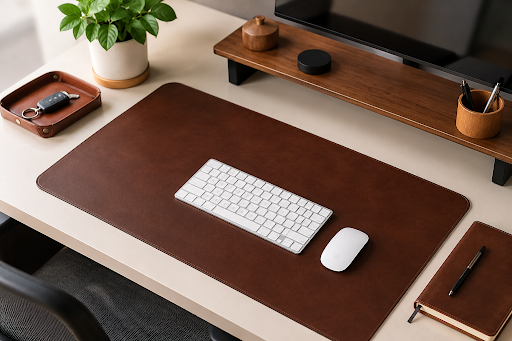
Looks are not the only reason to buy a desk pad, yet in a home office, they carry real weight. So much of work now happens on camera, and a polished desk reads as professional to everyone on the call. A leather pad gives the frame a clean, considered backdrop that a bare or cluttered desk cannot. It also pairs naturally with the rest of a thoughtful setup, sitting comfortably alongside a matching coaster, a catch-all tray, and your everyday tools. The upgrade is small in effort but noticeable in effect, lifting the whole room a step toward the kind of workspace that feels intentional rather than thrown together. Small as it seems, that backdrop shapes how people read your professionalism before you say a word. For people who host clients or interview from home, that impression is worth more than the modest price of the pad.
The Hidden Cost of Cheap Desk Mats
The sticker price on a budget mat looks appealing until you add up what it really costs over a few years. A cheap synthetic pad might run a fraction of a leather one, but most need replacing every year or two as the surface peels, curls at the corners, or stains beyond cleaning. Buy three or four of those, and you have quietly spent as much as a single leather pad that outlasts them all. The waste is not only financial. Each worn-out mat heads to the landfill, while a full-grain pad stays in service for years and ages instead of degrading. There is a focus cost too, since a frayed, curling mat is a small daily annoyance that chips at the polish of your whole desk. Spending once on a pad you never think about again is often the better deal, both for your wallet and for the workspace you sit at every day.
Is a Leather Desk Pad Right for Your Setup?
A leather desk pad is not for everyone, and it is worth being honest about that. If you barely use your desk, a budget mat will do. But if you work from your desk daily, value a workspace that looks and feels premium, and want a piece that lasts for years, leather is an easy call. A few practical points help you choose well. Consider the size first, measuring your desk so the pad fills the space without crowding your keyboard and monitor. Think about color next, since darker tones hide marks and pair with most desks, while lighter tones make a bolder statement. Finally, look at what comes with it, because some pads arrive as a set with a coaster and tray that round out the desk. Get those details right, and the pad fits your setup as if it were made for it.
A Desk Upgrade That Earns Its Keep
For anyone serious about their workspace, leather desk pads earn their cost through durability, desk protection, and a refined look that cheaper mats simply cannot match. As a long-term piece for a premium home office, they pay you back in years of service, a desk that stays in good shape, and a setup that always looks ready for work. The higher price buys something you stop having to think about, which is exactly what a good investment should do.
At Elizo, we craft our desk pads from certified full-grain leather, and many arrive as a set with a matching coaster and tray, all under our Luxury Engineered promise and hassle-free warranty. If you are ready to give your home office a finish that lasts, explore our leather desk pad collection, or browse our broader leather desk mat range to find the size and shade that suits your space. Outfitting a team or hunting for executive gifts, our corporate gifts program covers that too.
Questions People Ask
Are leather desk pads better than felt or synthetic ones?
For durability and looks, yes. Felt and synthetic pads wear out and need replacing, while full-grain leather lasts for years and ages into a richer finish, so it often costs less over time.
Will a leather desk pad work well with a mouse?
Yes, for most setups. A smooth leather surface gives optical and laser mice a consistent area to track on, and many people retire their separate mousepad after switching.
How do I keep a leather desk pad from sliding around?
Look for a pad with a suede or non-slip backing, which most quality leather pads have. The weight of a full-grain pad also helps it stay put on the desk.
What size desk pad fits a standard home office desk?
Measure your desk first, then choose a pad that leaves room around your keyboard and monitor. A large pad around 31 by 15 inches suits most standard desks, with smaller and larger options for tighter or wider setups.
How do I clean and maintain a leather desk pad?
Wipe spills quickly, dust it with a soft cloth, and condition the leather a few times a year. Avoid harsh cleaners, which strip the natural oils the leather needs to age well.