
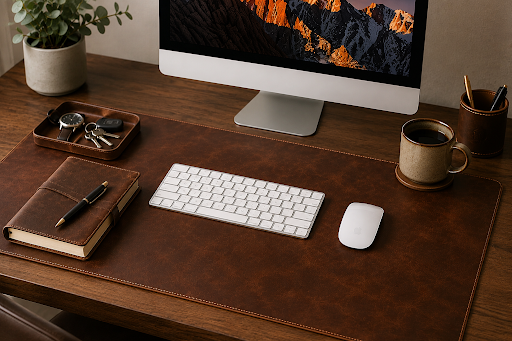
Most desk accessories look their best the day you unbox them, then go quietly downhill. A leather desk mat works the other way around. The faint ring left by a warm mug, the soft sheen where your wrist rests while you type, the gentle warming of color near a sunny window, all of it gathers into a surface that tells the story of your workdays. That slow change has a name, patina, and it is one of the best reasons to choose a leather desk mat over anything synthetic. Here is how that character actually develops, and how you can guide it.
What Patina Actually Is
Patina is the natural change in a leather’s color, sheen, and texture as it ages through everyday use. It is not damaged, and it does not wear the way a synthetic mat wears, fraying and flattening until you replace it. Patina is the leather maturing, deepening in tone, and developing a soft luster no factory finish can fake. Think of a well-loved baseball glove or a favorite pair of boots that look richer after years than they did when new. A leather desk mat follows the same path. The surface you start with is only the beginning, and the version you reach a year later, marked gently by your habits, is usually the one you love most.
The Science Behind the Glow
The transformation is not magic; it is chemistry and physics working slowly in your favor. Natural leather stays porous, so it absorbs the small amounts of oil from your hands and forearms every time you rest them on the mat. Those oils sink into the fibers and gradually darken and enrich the tone. Sunlight plays its part too, warming the color over weeks and months wherever the light falls most. Then there is friction. The constant, gentle contact of your hands, your mouse, and your sleeves polishes the high-traffic areas into a soft shine, the same way a wooden banister grows smooth and glossy where countless hands have passed. Each force is mild on its own, yet together they reshape the leather into something with real depth. Our guide on understanding leather patina covers the process in even more detail. This is also why patina is impossible to rush convincingly. The depth comes from many small exposures layered over time, not a single treatment, which is exactly what makes a well-aged mat look earned rather than manufactured.
Why Full-Grain Leather Patinas Best
Not all leather ages the same way, and the difference comes down to grade. Full-grain leather, taken from the top layer of the hide with its natural grain intact, patinas beautifully because its open fibers drink in oils and light instead of blocking them. That is what lets the color deepen, and the surface glow over time. Coated, bonded, or faux leathers cannot do this. A sealant or plastic layer sits on their surface, so they stay flat and lifeless no matter how long you use them, and in the end, they crack rather than mature. This is the heart of why a genuine leather desk mat made from full-grain leather is worth seeking out. It is the only kind that rewards you with character, and because the grain of every hide is unique, no two mats ever age into the same look.
How Your Daily Habits Shape the Look
The most charming part of patina is that you design it without trying. Where you write, where you set your coffee, where your wrist lands while you type, all of these guide where the leather darkens and shines first. A right-handed writer tends to develop a warm, polished zone on the right side of the mat, while a glowing band often forms across the front edge where forearms rest. Even the season plays a part, since drier winter air and brighter summer light each nudge the leather along at their own pace. Small scuffs and faint marks blend into this evolving surface rather than standing out, adding to the lived-in charm instead of spoiling it. In a real sense, your routine becomes the artist, and the mat becomes the canvas. Two people can buy the identical mat on the same day, and a year later, their mats will look distinctly different, each shaped by its owner.
Helping Your Desk Mat Age Beautifully
Patina develops on its own, yet a little care keeps it looking its best as it does. Wipe up spills promptly so liquids do not soak in unevenly or leave hard marks, and dust the surface now and then with a soft, dry cloth. Conditioning the leather occasionally, a few times a year, is plenty for most mats to keep the fibers supple and prevent drying. Let the mat breathe and catch some indirect light, which encourages an even, gradual darkening. Steer clear of harsh chemical cleaners and rough scrubbing, since both strip the natural oils that patina depends on. Our complete leather care guide walks through the simple habits that protect any leather piece. The goal is not to fuss over the mat; it is to let it age while keeping the surface healthy underneath.
Patina or Damage, Knowing the Difference
As your math changes, you might wonder whether a particular mark is a welcome character or real harm, and the distinction is easy to learn. Patina shows up as broad, gradual shifts, a deeper tone, a soft sheen, a gentle darkening across the areas you touch most. It looks intentional even though no one planned it. Damage, by contrast, tends to be sharp and sudden, a deep gouge, a stiff water stain with a hard ring, a patch where heat or a harsh cleaner stripped the surface. The good news is that full-grain leather forgives most everyday accidents, since light scratches often buff out with a clean finger or a soft cloth, and minor water spots usually even out as the leather dries and ages. Real damage is rarer and almost always traces back to neglect, like a spill left to soak overnight or a cleaning product never meant for leather. Treat the mat with the simple care above, and nearly every mark it gathers will fall on the patina side of the line.
A Surface That Becomes Uniquely Yours
Put all of this together, and you start to see why a leather desk mat is one of the few things on a desk that genuinely improves with use. While a synthetic mat marks its days by looking older and more tired, a quality leather mat marks them by looking richer and more distinctly yours. The character it gains is not generic; it is a record of your particular workdays, your particular habits, and even the particular hide it was cut from. For a deeper look at how patina forms across different leather goods, our overview of leather patina is a great next read. That quiet luxury is something we take seriously in how we source our hides, which you can read about on our sustainable leather page.
The Desk Mat That Tells Your Story
A leather desk mat is a rare desk accessory that grows more attractive the longer you use it. As patina settles in, the mat shifts from a clean new surface into a personal record of your work, rich with character that no synthetic mat and no factory finish can copy. Choose full-grain leather, use it daily, give it a little simple care, and you end up with a piece that feels entirely your own.
At Elizo, we make our desk mats from certified full-grain leather chosen specifically for how gracefully it ages, all backed by our hassle-free warranty. If you want a surface that earns its character over the years, start one of your own and let it grow with your workdays.
Questions People Ask
How long does it take a leather desk mat to develop patina?
You will usually notice subtle changes within a few weeks, with a richer, well-defined patina developing over several months of daily use. The exact pace depends on how often you use it and how much light it gets.
Can I speed up the patina on my leather desk mat?
Gently, yes. Regular use and some indirect sunlight encourage faster, even aging. Avoid shortcuts like random oils or heat that are not meant for leather, since they can stain or damage the surface.
Does conditioning my desk mat ruin the patina?
No, occasional conditioning protects the patina rather than erasing it. It keeps the fibers supple so the leather ages evenly instead of drying out and cracking.
Why is my desk mat darkening unevenly?
Uneven darkening is normal and comes from where your hands rest, where light falls, and where you use the mat most. Over time, these areas blend into a cohesive, characterful finish.
Will sunlight damage or improve a leather desk mat?
Indirect sunlight helps the leather develop a warm, even tone. Harsh, prolonged direct sun can dry the leather out, so a spot with gentle light is ideal.