
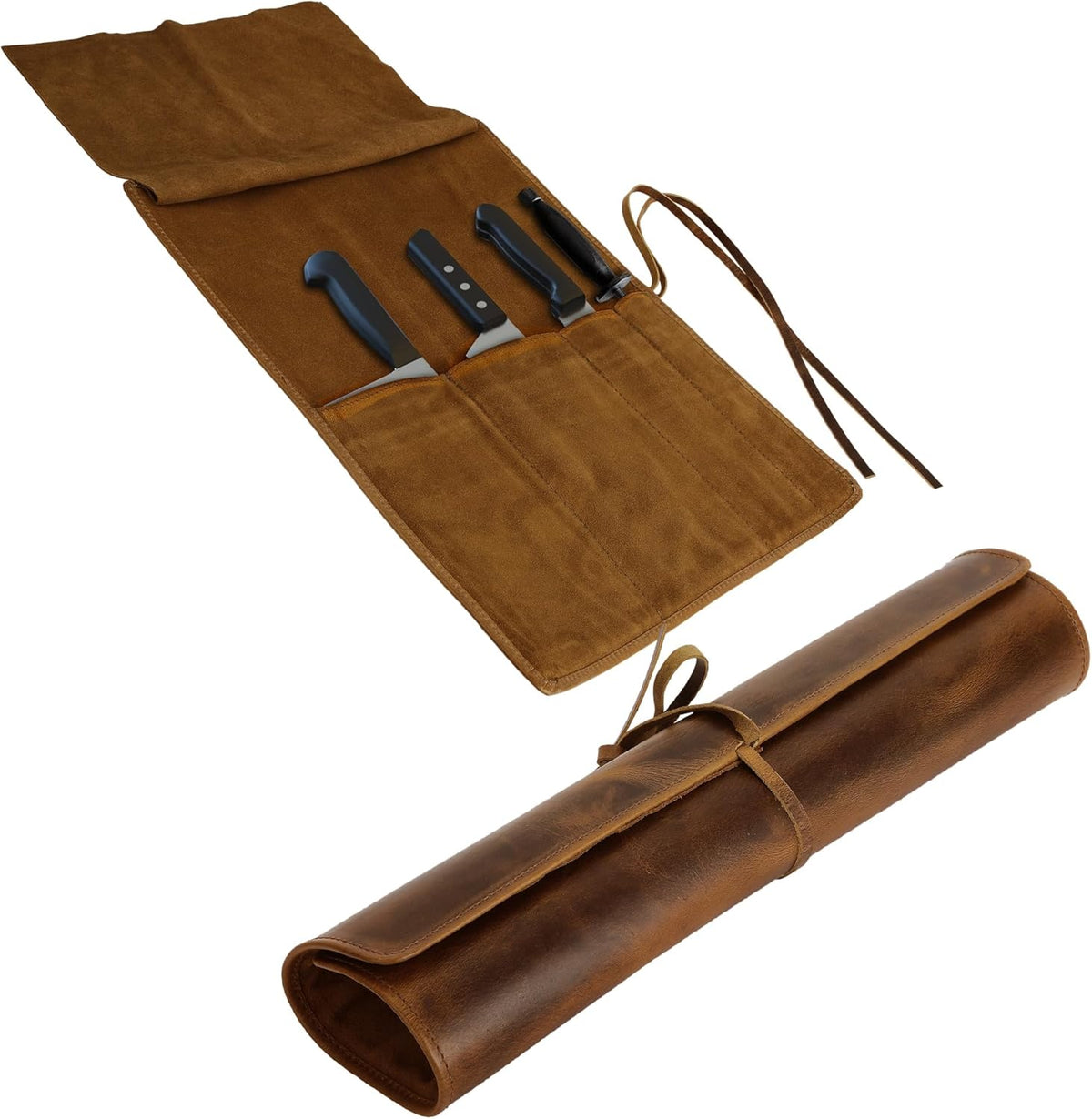
Good knives are an investment, and the fastest way to ruin one is to toss it loose in a drawer or bag. A knife roll keeps every blade in its own slot, protects the edges, and lets you carry your whole kit to work, school or a friend's kitchen. Here's how to choose the right leather knife roll for the knives you own.
Quick answer: A leather knife roll is a roll-up case with slots that keeps chef knives separated, protected and easy to carry. Count the knives you actually use (most cooks need 4 to 6 slots), make sure the roll is longer than your longest knife, and choose full grain leather with a suede lining so blades don't cut through. Good leather knife rolls last for years and get better looking with use.

Full Grain Leather Knife Roll for Chefs (Classic)
What Is a Knife Roll?
A knife roll (also called a knife wrap, knife bag or chef knife case) is a flat case with a row of slots or pockets. You slide each knife into its own slot, fold a flap over the handles or blades, roll it up and tie or buckle it closed. Rolls are lighter and slimmer than hard knife cases, which is why chefs have used them for generations.
How to Choose a Leather Knife Roll
1. Count your knives
Lay out the knives you actually use each week. Most cooks need a chef knife, a paring knife, a bread or slicing knife and a honing rod. That's 4 slots. If you also carry a boning knife, utility knife, shears or a fish spatula, look for 6 slots or more. A few spare slots let your kit grow.
2. Check the length
Measure your longest knife from the tip of the blade to the end of the handle. The roll should be longer than that so the tip is fully covered and nothing sticks out when it's rolled up. An 8-inch chef knife (the most common size) fits comfortably in a 17-inch roll.
3. Choose full grain leather
Leather is the classic knife roll material because it's tough, cut-resistant and ages well. Full grain leather is the strongest grade. It holds its shape, resists moisture, and develops a patina instead of fraying like canvas or peeling like faux leather. Learn more in full grain vs. genuine leather.
4. Look for a protective lining and flap
A thick suede lining and a fold-over flap stop blade tips from cutting through the leather and keep handles from sliding out. This is the detail that separates a knife roll that lasts years from one that wears through in months.
5. Pick a closure you like
Wrap-ties are simple and adjustable. Buckles and straps feel more secure if the roll lives in a bag. Either works, so choose what's quickest for you to open and close during a shift.

Full Grain Leather Knife Roll – 6 Slots (Antique)
Which Elizo Knife Roll Is Right for You?
All three are made from full grain leather. Choose by how many knives you carry:
| Knife roll | Holds | Size (open) | Best for | Price |
|---|---|---|---|---|
| Classic | Chef knives up to 8" plus a honing rod | 17" × 14" | Home cooks, a starter set, gifts | $39.97 |
| 4-Slot (Ironwood) | 4: chef knives, smaller blades and a honing rod | 17" × 14" | Culinary students, a core everyday kit | $47.99 |
| 6-Slot (Antique) | 6: a fuller set including smaller blades and tools | 17" × 20" | Working chefs, catering, travel | $59.97 |

Full Grain Leather Knife Roll – 4 Slots (Ironwood)
Leather vs. Canvas vs. Nylon Knife Rolls
- Leather: most durable and cut-resistant, ages well, looks professional. Costs more, needs occasional conditioning.
- Waxed canvas: lighter and cheaper, but frays at the edges and stains easily in a kitchen.
- Nylon: cheapest and water-resistant, but blade tips cut through it over time and it looks worn quickly.
If you're carrying knives that cost more than the roll, leather is worth it.
How to Care for a Leather Knife Roll
- Always dry knives completely before rolling them up.
- Store the roll open or loosely rolled so the leather can breathe.
- Wipe spills with a damp cloth and let it air-dry away from heat.
- Condition the leather every few months to keep it supple.

Personalized Leather Knife Rolls
What to Put in Your Knife Roll
A well-packed roll holds the tools you use most, with heavier knives toward the outside so the roll stays balanced. A typical kit looks like this:
- Chef knife (8 inch): the everyday workhorse for chopping, slicing and dicing.
- Paring knife (3 to 4 inch): for peeling, trimming and small detail work.
- Serrated bread or slicing knife: for bread, tomatoes and carving.
- Honing rod: keeps edges straight between sharpenings.
- Extras for a 6-slot roll: a boning knife, utility knife, kitchen shears, a fish spatula or tweezers for plating.
Use edge guards on very sharp or expensive blades for extra protection, especially if the roll gets packed in a bag with other gear.
How to Carry Knives Safely
Always roll your knives with the edges facing the same direction and the flap folded over so no tip is exposed. Tie or buckle the roll snugly so knives can't slide out of their slots. Carry it in a backpack or tote rather than loose in a car. If you're flying, knives can't go in your carry-on in the US, so pack the roll in your checked bag. Before carrying knives in public, check your local laws, since rules on carrying blades vary by city and state.
A Knife Roll Makes a Great Gift for Chefs
Chefs, culinary students and home cooks all use a knife roll, which makes it one of the safest gifts for anyone who loves to cook. Add initials or a name for a personal touch. See our personalized gifts.
Frequently Asked Questions
What is a knife roll used for?
A knife roll stores and carries kitchen knives safely. Each knife sits in its own slot so the edges don't knock together, and the roll wraps closed so the blades can't cut you or your bag. Chefs use them to bring their own knives to work, culinary school or catering jobs.
How many slots do I need in a knife roll?
Count the knives you reach for every week, then add one or two. Most home cooks use 3 to 4 (chef knife, paring knife, bread or slicing knife, honing rod). Professional cooks and culinary students usually want 6 or more.
Is a leather knife roll better than canvas?
Leather lasts longer, resists cuts and moisture better, and looks better with age. Canvas is lighter and cheaper but frays and stains. Full grain leather with a suede or thick lining gives the best blade protection.
Can I put wet knives in a leather knife roll?
No. Always wash and dry knives completely before rolling them up. Moisture trapped against leather can stain it and can cause rust spots on carbon steel blades.
How do I clean a leather knife roll?
Wipe it with a damp cloth, let it air-dry away from heat, and rub in a leather conditioner every few months. Don't soak it or put it in a washing machine. See our leather care guide.
Is a leather knife roll a good gift for a chef?
Yes. It's one of the most useful gifts for chefs, culinary students and serious home cooks, and it's personal without needing to know their taste in knives. A monogram makes it even more personal.
How long should a knife roll be?
Longer than your longest knife from blade tip to the end of the handle. A 17-inch roll fits the most common 8-inch chef knife with room to spare, so the tip stays fully covered when the roll is closed.
Does a knife roll dull your knives?
No. A good roll actually protects the edge, because each knife sits in its own slot and blades don't knock against each other. Dulling usually comes from loose knives rattling in a drawer or bag.
Can I take a knife roll on a plane?
Not in your carry-on. In the US, the TSA doesn't allow knives in carry-on bags, but you can pack your knife roll in checked luggage. Wrap or sheath the blades so baggage handlers stay safe.
Can a knife roll be personalized?
Yes. Leather takes embossing well, so initials, a name or a restaurant logo can be added. It's a popular choice for culinary school graduations and gifts for chefs.
Shop Leather Knife Rolls
Browse every size in our leather knife roll collection, made from full grain leather and built to protect your knives for years.